
Checking for a Warrant in Grambling
Grambling posts no public warrant search. For a city warrant lookup, call the court clerk or the magistrate. At the parish level, the clerk and the sheriff handle a county check, so work the city steps first.
- Read the citation and confirm whether it names Grambling City Court or a parish court.
- Call the city court clerk or magistrate and ask whether the docket shows a current warrant.
- Ask for the case reference and the missed appearance date if one exists.
- Ask whether the city police or the marshal holds the service assignment for that case.
- Call the parish clerk when the paper names a district criminal or parish traffic case instead.
Note: A Grambling ordinance ticket and a state traffic citation can land in different courts, so the filing court decides the route.
City Hall, the Magistrate, and the Clerk of Courts
Grambling's official government page names three public roles in any warrant question. One is the police department. Another is the city magistrate, and the third is the clerk of courts. Each answers a different part of the same case.
Start at City Hall for the municipal path. The clerk of courts can describe what the docket shows, and the magistrate hears the city cases. Neither office speaks for a district-court file. The parish clerk, in turn, cannot answer for a Grambling city file. Note: The published city listings identify offices, not residents, so keep a records question at the office level.
Grambling Police and Municipal Court
The Grambling police write city citations and serve process within their authority. The municipal docket belongs to the city court and magistrate. Marshal duties and the court's payment route run through the contacts below.
Grambling Police Department
127 King Street
Grambling, LA 71245
318-247-3771
Grambling City Court
P.O. Box 109
Grambling, LA 71245
318-596-3142 ext. 5
If a date has already been missed, call the Grambling court before paying anything. The court controls the case status, and a payment screen does not speak for the judge.
The Payment Page Is Not the Court
The Grambling city court's payment page is just a payment access point that the city links from its own material. It is not the court. It offers no warrant search, no roster, and no live control over case status.
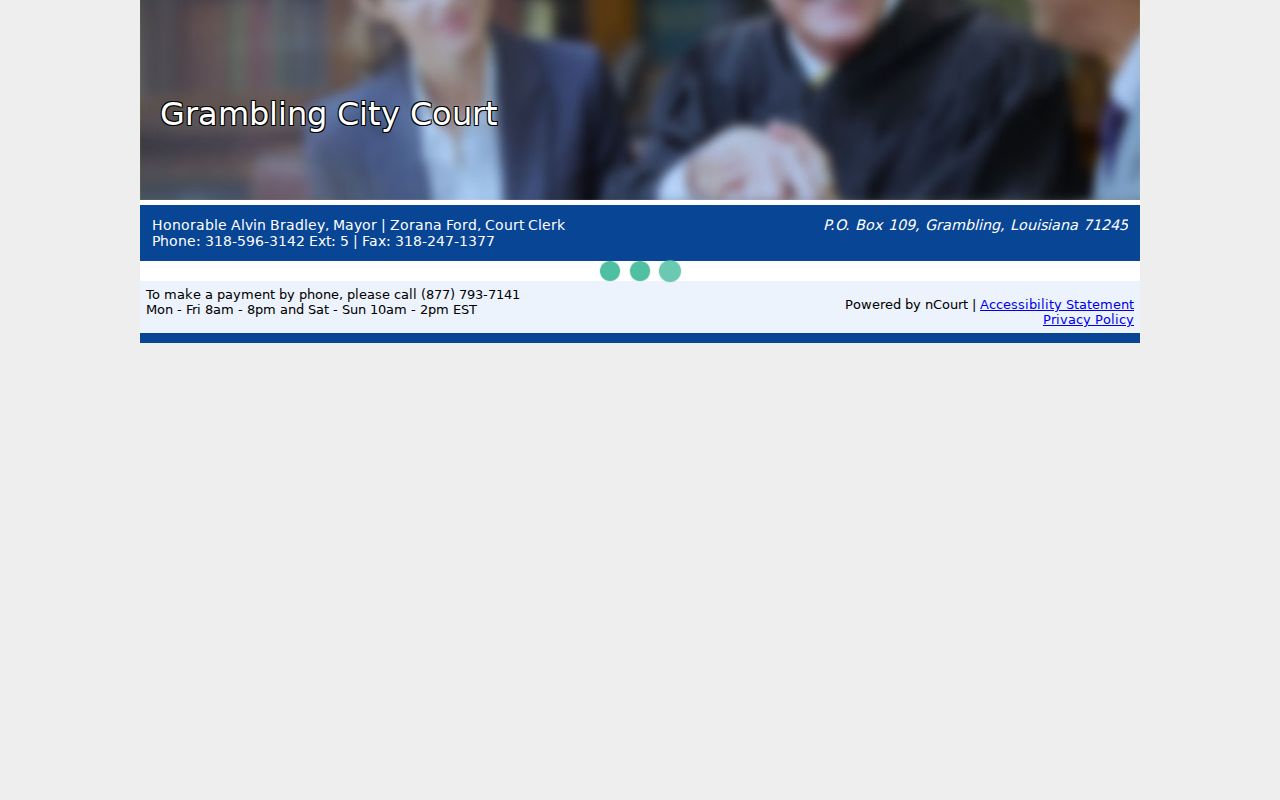
Three things follow. A completed transaction does not prove a warrant was recalled. The vendor cannot answer a question about your case. The Grambling court clerk, not the payment vendor, can confirm what the docket records.
Caution: Confirm with the court before paying after a missed date, because a payment may not address the underlying warrant entry.
Grambling Warrant Types
Grambling residents run into four warrant types, and only the first three belong on the city docket.
| Warrant Type | How It Arises | Who Issues It |
|---|---|---|
| Ordinance warrant | An unresolved city code or municipal violation | Grambling City Court or the magistrate |
| City traffic warrant | An unpaid city citation or a missed city date | Grambling City Court |
| Failure-to-appear bench warrant | A missed municipal setting | The city judge or magistrate |
| Arrest warrant | A charge filed after an investigation and probable-cause finding | A parish magistrate or district judge |
A state-law traffic case may sit outside the mayor's court entirely. That is why the filing court in Grambling matters more than the officer who wrote it.
Grambling Warrant Cases and the University Setting
Grambling is a university city, and its own page describes that setting as part of its public-institution context. Campus life does not change the legal routing. It does create one common misreading. A citation written near campus, or by a city officer, is still a Grambling matter unless it was filed under state law in another court. The university never holds the case, and the parish clerk does not either when the citation was filed municipally. Ask for the docket court and the citation number instead of assuming from the location. That habit guards against a second error, too: treating a campus incident report as a warrant record. An incident report comes from an agency. A warrant is issued by a court. Only the court's paper starts a warrant question.
Inside a Grambling Warrant Record
A Grambling warrant record is short, and the first two fields decide which office answers the rest.
| Case or citation reference | The municipal docket or ticket number, formatted such as MC-2026-00931. |
|---|---|
| Issuing court | Grambling City Court or the magistrate for a city matter, or a parish court for a state case. |
| Subject identity | The name on the citation, or a description when identity is not confirmed. |
| Charge or violation | The city ordinance or traffic violation at issue. |
| Amounts owed | The fine, costs, and any contempt amount the city judge has set. |
| Status | Active, recalled, or resolved, as the city court records it. |
Ask the clerk to read the docket entry rather than paraphrase it. Then request a copy of any order that clears the warrant from the Grambling record.
Grambling Warrant Questions for the Court Clerk
A missed date produces the same questions in every city, so a short list keeps the call efficient for a Grambling warrant check. Ask these in order and write down the answers.
- Does this citation or case number show a current warrant on the docket?
- Which judge or magistrate set the case, and what did the missed setting record?
- What does the court require next: a reset, a payment, a bond, an appearance, or a written motion?
- Can counsel appear on the person's behalf, or is a personal appearance required?
- What document will show that the warrant was cleared, and how long does the update take?
The clerk can describe the record and the court's process. The clerk cannot predict an arrest, promise an outcome, or give legal advice, so save those questions for an attorney in Grambling.
How Grambling Warrants Fit the County System
City cases stay with the city until the charge itself belongs elsewhere. A Grambling ordinance or city traffic matter stays a Grambling court case. A district criminal case goes to the parish clerk and the Third Judicial District Court instead.
Warrant flow: Grambling City Court and Police › Lincoln Parish Sheriff › parish court records and state administrative holds
Parish ticket collection shows how the layers separate. The sheriff's guidance names tickets from the sheriff, state police, and the village of Choudrant in its route, and it does not say every Grambling municipal case follows the same path. Verify the filing court first. The Lincoln Parish warrant records page lists the county-wide channels for a Grambling warrant search.
Grambling Police and the County Sheriff
Two law-enforcement offices can appear in a Grambling case, and each answers for its own role. The Grambling department handles city investigations, citations, and service within its authority. The sheriff handles parish investigations, custody, and the parish ticket route.
Work from the right office. If a Grambling officer wrote the citation, start with the city. Parish cases go to the sheriff, and any agency that served a warrant is the one to confirm its own entry. Neither office posts a warrant list. Both answers come from a person, not a search box. Note: A custody roster shows who is in jail, not who has an open warrant, so it is never a status result.
What Grambling Figures Say About Warrants
Grambling's published figures describe the city and how its court is set up. No warrant count appears for the city or the parish.
Read those numbers as structure, not volume. Grambling runs its own magistrate and clerk, yet district cases still route to the parish, and no published figure changes that.
Grambling Warrant Records and Public Access
City court files in Grambling are public under the Louisiana Public Records Law, La. R.S. Title 44. The usual limits apply. The city clerk can release an existing record but cannot forecast an outcome.
Key Rules:
La. R.S. 44:31 - An adult may inspect and copy public records, and the office holding the record must justify a refusal.
La. R.S. 44:3 - Law-enforcement records tied to protected investigative material may be withheld.
Children's Code confidentiality rules limit access to juvenile matters.
Name the court and the case reference in any request. That detail matters. If the matter is a parish case, the Grambling clerk will say so, and the request then moves to the parish clerk rather than the sheriff.